On-street electric vehicle (EV) charging is a fast-growing area of the UK’s public charging network. It provides a solution for electric car drivers who live in a flat or a house with no off-street parking, and are therefore unable to charge their car at home.
If you’re thinking about making the switch to an electric car, you’re probably aware that it’s often cheaper and more convenient to charge at home. However, a home charger is certainly not a requirement for an electric lifestyle. If you’d like to drive an electric car but live, for example, in a flat – this is where on-street or' near-home' residential charging comes in useful.
If this is you, scroll on for more info and advice about on-street charging in the UK.
On-street/near-home charging in the UK
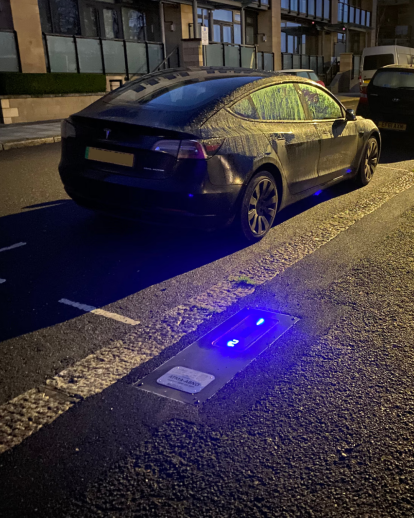
Across the country, local councils are working together with charge point operators such as Connected Kerb, char.gy, Shell Recharge ubitricity and Urban Fox to install on-street chargers for public use.
Walking around your neighbourhood, you’re likely to see quite a range of on-street charging solutions popping up. You’ve probably come across charging devices in converted lampposts as well as bollard-style charge points already – some of the most common solutions. Operators tend to design these charge points to be as simple as possible in order to fit neatly into their surroundings - Urban Fox even has a 'disappearing' charge point which retracts back into the pavement when not in use, leaving pavements clutter-free and accessible for everyone.
How quick are on-street charge points?
Most on-street charge points will have a power rating of 3kW, 5kW or 7kW, and are ideal for overnight charging. Depending on your EV model, the power rating of the charger, and the weather conditions, these charge points will generally take between 6-12 hours to recharge your car to 80% or above.
You may, however, come across some on-street chargers that have a power rating of 22kW. These will power up your car battery in a couple of hours.
What do on-street charge points look like?
On-street charge points are mostly ‘untethered’ so you’ll need your own cable to use the charger. Below are some common examples of bollard and lamppost-style charge points which are the most common type. These particular charge points are examples from on-street provider char.gy, with further styles from Connected Kerb and Shell Recharge ubitricity.

The char.gy Bollard
A slimline, stand-alone compact charge point, which can make use of existing infrastructure. You’ll find bollards on the roadside or in car parks.
The char.gy Backpack
The char.gy backpack fits onto existing lampposts and walls, making use of an existing electrical feed. The benefit of converting lampposts is that it makes very good use of space, avoiding any potential access restrictions.


The Connected Kerb Chameleon
The Chameleon is a dual charger, meaning that two EVs can charge at once via its two charging sockets. It’s a bollard style charge point which you’ll find on roadsides and in car parks.
The Connected Kerb Gecko
The Gecko is designed to blend into the environment due to its size and simple design. You’ll usually find Geckos attached to lamp posts or bollards, often with more than one unit attached for multiple EVs to be charged from.


Shell Recharge ubitricity lamppost charger
Shell's on-street lamppost chargers are designed to fit into existing street furniture to keep footpaths clear, with the purpose of being used for overnight and long-dwell charging at a charge rate of up to 5.5 kW.
Shell Recharge ubitricity bollard charger
Shell's bollard chargers utilise existing power from street lights, reducing street clutter as there is no need for a separate metered cabinet, making them ideal for roads with no or sparse street lights or lights further away from the kerb. The bollards are designed to self-right after any vehicle strike or impact and typically charge at 5kW.

How to find an on-street charge point
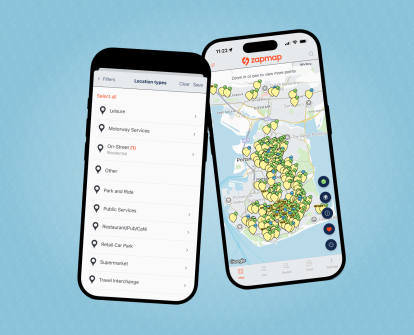
Wherever you are in the UK, you can locate charging points in your local areas quickly and easily with the Zapmap app or desktop map, and see the live availability status of more than 95% of these charge points 24/7.
To easily find nearby on-street chargers, you can filter by location type, and select ‘On-Street’.
How to pay for on-street charging
Connected Kerb, Urban Fox and char.gy are all on-street providers whose chargers can be paid for directly in the Zapmap app, and Connected Kerb and Urban Fox can be paid for by using a Zapmap charging card.
Paying with Zapmap via the app or Zapmap charging card avoids the hassle of using multiple apps or RFID cards across different networks. You just need to add the credit or debit card you wish to use into the 'Payment method' section in ‘Settings.’ You can also use Apple Pay or Google Pay. You can also order a Zapmap charging card in the app in a couple of minutes. Just head to the settings menu, select the ‘Charging card’ option, and follow the in-app instructions.
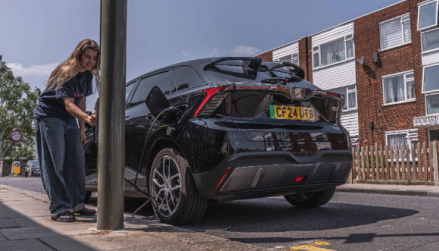
char.gy accepts payments via the Zapmap app.
When paying via Zapmap you can check the app at any time to view the progress of your charge and see receipts from previous charging sessions.
You can learn more about ways to pay in this handy guide on how to pay for public charging in the UK.
How many on-street chargers are there in the UK?
The UK has over 115,000 EV chargers as of the end of January 2025, of these over 4,000 are operated by char.gy, and almost 7,000 by Connected Kerb.
Many local councils are starting to join forces with charge point operators to roll out provision of on-street chargers thanks to government funding programmes. In many cases, the charge point operator will fully fund the delivery, installation and maintenance at no cost to the local council.