What has changed in reporting on public charging?
In the UK, Zapmap and the Department for Transport have been tracking the amount of charging provision since 2014, leading with the devices metric in reporting. In February 2026, the leading metric has been changed to EV chargers (EVSE) to more closely reflect the number of EVs that can be charged simultaneously. In parallel, the power band labels have been updated to provide more intuitive language for consumers. More detail and rationale is provided below.
What terminology is used in public charging?
The different components of public EV charging infrastructure are described below and the diagram shows how they relate to each other.
Location - A site at which a Charge Point Operator (CPO) operates one or more charging devices;
Device - A physical unit at a charging location which contains charging equipment;
Bay - A parking space from where an EV can be charged;
EV charger - An independent part of a charging device which controls the charge session, enabling one EV to charge at a time. Also known as EVSE (electric vehicle supply equipment);
Connector - A socket or plug that connects EV chargers to vehicles.
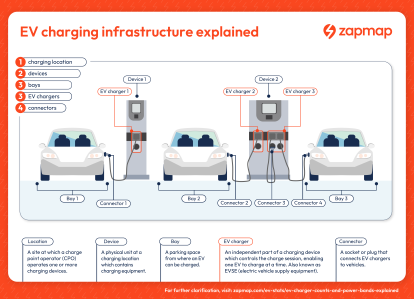
How does Zapmap and the Department for Transport now track the profile and growth of public charging provision in the UK?
Zapmap and the Department of Transport have been tracking public charging infrastructure since 2014. From 2026, in the UK, Zapmap and the the Department for Transport have moved to EV charger (EVSE) as the topline metric for EV charging provision, as it is now considered to be the best and most reliable way to report on the size of the public network.
Historically devices were used as the best proxy for the number of EVs that could charge simultaneously, as the OCPI protocol for sharing data on public charging (which identifies EV chargers - EVSE) was not yet embedded in the market, and counting connectors would have been an overestimate.
As the market has developed in the UK, charge point operators have widely adopted OCPI as the preferred mechanism for sharing data. Alongside the Public Charge Point Regulations 2023, which mandate the provision of open data for each public EV charger, this protocol make it possible to count EV chargers (EVSE) and use this count as the primary metric.
What is the benefit of moving to count EV chargers compared to continuing to count devices in the UK?
Counting EV chargers is the closest way to report on how many cars can charge simultaneously on the public network. It is a better proxy than the device count for the true amount of public charging provision available.
EV chargers are used as the standard metric for measuring the size of the public network throughout Europe and in many countries across the rest of the world. So international comparisons of public network size are more easily and accurately made using the EV charger count.
Does the count of EV chargers tell you how many cars can charge simultaneously at that location?
Typically yes, one EV charger can charge one EV. The number of EV chargers at a location is usually how many EVs can be charged at that location. This is the reason why the number of EV chargers is the metric most representative of the availability of public charging.
There are circumstances that can reduce the number of EVs that are able to charge simultaneously at a given location, including:
EV charger downtime, where a charger is inoperative or out of order
limited availability of parking bays, such as when a vehicle is occupying a designated charging space without actively using the charger
charging devices where two EV chargers cannot be used simultaneously, for example for some devices with both CHAdeMO and CCS connectors or where only one bay has been allocated to a device with two EV chargers
At present, the OCPI versions widely used by charge point operators to communicate with eMSPs like Zapmap do not include a field to communicate the bay count for each EV charger; this would be the ideal way to count exactly how many cars could be charged simultaneously across the UK’s public charging network.
Why is the term 'charge point' not used in these metrics?
The term "charge point" (or “chargepoint”) is in common usage, both formally and informally, to mean many different things. Each of the components defined in the EV charging infrastructure explained diagram can be, and have been, described as a “charge point” by users depending on their use case.
Counting any of these components provides a different total, meaning that any count of the number of “charge points” would be misleading to some users. To provide clarity and avoid ambiguity, the term “charge point” is no longer used by Zapmap or the Department of Transport in charging infrastructure statistics.
General use of the term “charge point” is not discouraged. Both charge point and EVSE are defined in legislation. Using these legal definitions, the term “charge point” refers to the number of charging devices, not the number of EV chargers.
What has changed in terms of the power bands referred to by Zapmap and the Department for Transport?
Historically the four speeds or power ratings that are tracked were defined as Slow (from 3kW up to 7.9kW), Fast (from 8kW up to 49kW), Rapid (from 50kW up to 149kW) and Ultra-rapid (150kW and above).
In order to modernise the naming conventions for the power bands at the lower end of the scale, in February 2026 these were renamed to Standard (from 3kW up to 7.9kW) and Standard Plus (from 8kW up to 49kW).
The power band naming conventions of Rapid (from 50kW up to 149kW) and Ultra-rapid (150kW and above) are being retained.
Where possible, the focus when referring to the power rating of EV chargers will be on the numeric kW value, as this is clearest for new and existing EV drivers in terms of what they can expect from the performance and features of EV chargers at that level.
The table below highlights the change and provides context around the power bandings themselves. The purpose of this update is to provide consistent and standardised naming conventions to aid clarity for new EV drivers.
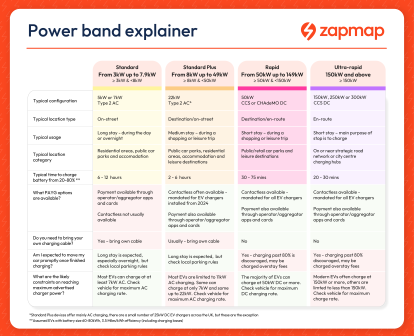
Why are the terms "slow" and "fast" no longer used by Zapmap and the Department for Transport to describe under 50kW charging?
Different charging power bands are useful for different purposes, as outlined in the table above. What has previously been referred to as Slow (from 3kW up to 7.9kW) charging can be the most appropriate level of power delivery (for example, overnight on-street charging) but the term "slow" can be interpreted to mean inferior. There has also been long term agreement among government and industry that "fast" is a particularly misleading term, with "fast charging" commonly used to indicate 50kW and above EV chargers both here and in Europe.
The terms Standard and Rapid are reflective of the needs and expectations of charging power for different purposes. Splitting these into further subcategories (Standard and Standard Plus, Rapid and Ultra-rapid) allows for a finer understanding of the availability of public charging to meet specific needs.
Does the power band of an EV charger (EVSE) guarantee the amount of power delivered to an EV?
No. In Zapmap and the Department for Transport statistics, the power band of an EV charger is defined as the maximum potential power delivered by its highest power connector. An EV charger could deliver lower power than the lower limit of the power band for several reasons including but not limited to:
- the electric vehicle having maximum AC or DC charging lower than the advertised power of the EV charging
- the electric vehicle battery management system limiting power input to manage battery health
- use of "load management" reducing the power delivered when multiple EVs are charging from a single power source
- insufficient grid power available at the location
Where can I see up-to-date counts of the numbers of EV chargers in the UK?
The Zapmap EV charging stats page is updated monthly with the total number of EV chargers in the UK and their breakdown by power band, use case and network.
The Department for Transport release monthly and quarterly official statistics tracking the growth of the public EV charging network in the UK.
If you are interested in more in-depth data and analysis on the EV charging market for your business, find out more or get in touch with the Zapmap Insights team.
Please note that third parties can use this data provided the source is clearly attributed to Zapmap, any graphs include the Zapmap logo, and a link is added back to https://www.zapmap.com in the body of the article. The data must be strictly copied and updated manually, no automated data collection can be applied in any form. The data can only be published in its original state and without any modifications.