Zapmap has published new statistics on public EV charger installations in the first quarter of 2026.
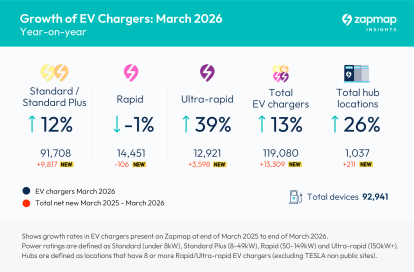
The figures taken from the Zapmap database at the end of March 2026 show 3,028 new EV chargers* were installed in the first quarter of 2026. The EV charging infrastructure now encompasses 119,080 EV chargers at 46,107 locations spanning en-route, destination and on-street charging. The new installations represent a year-on-year increase of 13%.
The highest growth continues to be seen in Ultra-rapid chargers delivering charging speeds of 150kW and above, as well as in charging hubs typically located along the strategic road network and designed for drivers looking to recharge their vehicle as quickly as possible on longer journeys. There are now 12,921 EV chargers in this power band, 39% more than in March 2025, and a corresponding marginal drop in the number of Rapid chargers, as devices are upgraded to higher power ratings.
The number of charging hubs across the country (defined as eight or more Rapid or Ultra-rapid EV chargers at a single location**) now stands at 972, with 46 of them being added to the Zapmap database in the past quarter. Zapmap data shows that, while the average number of EV charger provision at hubs has been very consistent over the past year (≅12), within this, Ultra-rapid EV charger count has steadily increased (from <8 to 8.5) as network upgrades are made.
Significant new hubs since Zapmap’s last quarterly update include:
- IONITY, in partnership with Hubber, opened its most urban site to date, at Aston in Birmingham city centre, providing 12 Ultra-rapid chargers with speeds of up to 400kW
- Duracell E-Charge, launched its second site, a short distance from the Metrocentre in Newcastle, providing charging of up to 300kW for 12 EVs
- GRIDSERVE announced the opening of a new hub with Roadchef at Folkestone Services, providing 12 Ultra-rapid chargers with speeds of up to 360kW
- Osprey Charging opened a new hub at Twyford Services, Evesham, providing 16 Ultra-rapid chargers – one of the largest public charging hubs in the region
Destination charging, where people charge when stopped, rather than stopping to charge, covers several use cases, and for those cases with a sub-four hour dwell time, such as gyms and supermarkets, whilst <50KW remains the majority, there is a trend towards installing more Rapid / Ultra-rapid charge points in these locations.
Developments over the past quarter include:
- A partnership between RAW Charging and Landsec to deliver charging for 1,000 EVs across 28 retail locations, including Bluewater shopping centre, Kent, which promises to be the largest retail destination EV charging hub in the UK
- Charging of up to 150kW for 16 EVs went live at Ravenside retail location, Chesterfield, as part of the same RAW Charging / Landsec collaboration
- IONITY opened two new charging locations in Scotland, providing Ultra-rapid charging in Inverness and Fort William, close to Ben Nevis
Many destination chargers are still Standard / Standard Plus (<50kW) and provide charging for longer stops and top-ups, such as in car parks and at tourist attractions. Combined with on-street charging, also predominantly <50kW, there are 91,708 chargers in this category, representing 77% of the total.
On-street chargers, designed for overnight or full-day charging, are aimed at drivers who wish to charge close to home but do not have off-street parking — this category is likely to become increasingly significant as more drivers make the transition to electric vehicles. This use-case has seen 6,552 new additions over the past twelve months, bringing the total to 37,122.
While the capital continues to lead the way on both EV adoption and on-street charging, with the majority of these chargers (25,463) located in Greater London, the first quarter of 2026 saw many announcements around the award of LEVI (Local Electric Vehicle Infrastructure) contracts. LEVI funding is designed to deliver local charging, typically on-street, especially in areas where charging at home isn’t an option. With the tender and commercial contract process for these awards taking longer than initially expected, we are yet to see these announcements translating into a significant impact on the figures.
Announcements of LEVI awards in the first three months of 2026 included:
- Believ began its rollout of c. 6,000 chargers across Suffolk, supported by £5.3m of LEVI funding
- Believ also announced its partnership with Plymouth City Council to deliver around 440 dual chargers across the city by 2028, with the first installations expected this summer
- Urban Fox secured a 20-year contract with Kent County Council to supply up to 10,000 chargers across the county
- Dorset Council and Bournemouth, Christchurch and Poole Council joined forces to deliver over 3,000 on-street EV chargers over the next five years, with Connected Kerb securing the LEVI-supported contract.
Zapmap’s latest charging statistics come alongside news from the Society of Motor Manufacturers & Traders confirming March as the best month on record for Battery electric vehicles (BEVs) with 86,120 registrations in the month, a YoY increase of 24.2%. This brings the total number of pure-electric cars on the UK's roads to 1,971,764.
Melanie Shufflebotham, Co-founder & COO at Zapmap, said:
“Steady growth in the roll-out of charging infrastructure has continued in the first quarter of the year. It’s encouraging to see 46 brand new hub locations, throughout the length and breadth of the British Isles. This is what Zapmap’s driver satisfaction survey consistently tells us EV drivers most want and need.
“At the other end of the charging spectrum, we’re also pleased to see LEVI contracts beginning to be awarded and on-street installations getting underway; this is all import as we see a record number of drivers this month making the transition to electric vehicles.”
Jarrod Birch, Head of Policy and Public Affairs, ChargeUK said:
“In a record month for EV sales the charging industry has delivered another strong quarter. Nearly 40% year on year growth in Ultra-rapid charging with EV hubs popping up all over the country is giving drivers the confidence to make the switch, whilst a strong pipeline of LEVI funded on-street and near-home chargers will soon come through to make it more feasible for those who cannot charge at home. As the Iran conflict is pushing petrol prices up and consumer interest in going electric is growing, now is the time for the government to double down on EVs with stable policy and addressing the affordability of public EV charging.”