What does sharing a home charger involve?
The easiest way is through one of the home charger sharing apps. The apps help with the ‘matchmaking’, the arrangements and payments – things that can be a big hassle to do independently. The drivers contacting you may already have an EV, or they may be looking for a viable means to charge it regularly before buying one.
Different apps work different ways to suit various scenarios, so it’s good to check on the particular approach, and the type of users an app is aimed at, before making a decision. Different apps also have approaches to fees or subscriptions, to the way sessions are booked and priced, and of course coverage is a key consideration.
If you are particularly looking to share with neighbours rather than people from further afield wanting a one-off charge, then check that the app is aimed at what you want. These are two very different scenarios in practice.
How much can I earn?
It depends on how many drivers you host, how often they charge, and your pricing. The other big factor is how much you pay for your electricity, and a variable EV tariff, along with a suitable arrangement of timing with those charging, can significantly boost your profit while passing some of that benefit to your guest.
Figures vary hugely due to these factors and which app you use. Based on figures from Co Charger, a charger sharing app suggest that a single private driver, charged at a modest markup, typically brings in around £200 a year after fees and the cost of electricity. Hosts with three or four regular private drivers can expect £600 to over £1,000 a year. Hosting a single professional driver on higher mileage, such as an Uber or fleet hire driver, can bring in over £1,000 a year on its own.
What are the other benefits to sharing my home charger?
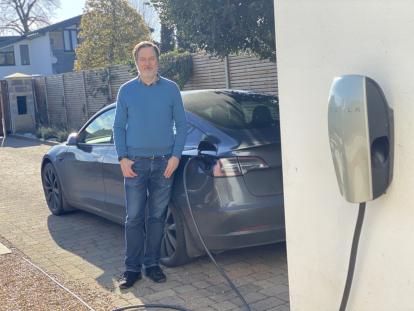
For a lot of people, money is not the main motivator. Research shows that many people like knowing they are helping a neighbour who would otherwise continue to drive a fossil fuel vehicle. Others value that it's an easy way to support cleaner air for their neighbourhood. For most hosts, it's a genuine mix of the three: the income, the community benefit and the environmental one, rather than any single reason standing alone.
What if someone books my charger and then I need to use it myself?
You choose which bookings to accept. In practice hosts rarely use their charger more than once or twice per week themselves, so it is easy to work out when bookings suit everyone. Some apps even enable regular chargees to schedule recurring, weekly sessions in one go.
Do I need to let strangers onto my property or into my house?
No. Firstly, because if you are focused on helping neighbours, it will be the same person or people regularly, so not strangers.
But regardless of who is using the charger, charging happens on the driveway only, and hosts are never expected to give access to the house itself. Meeting the driver in person on the first session is common practice, largely so the host feels comfortable accepting future bookings without needing to be there, but it is not compulsory and the arrangement can run entirely through the app once trust is established.
Who typically uses shared home chargers?
A wide range of people, most commonly those without off street parking, such as flat residents or those on streets of terraced housing with no driveway. Others have not installed chargers because they rent their home.
Professional drivers, particularly drivers who rely on the vehicle for a living, make up a significant and growing share of users. Fleet operators are also starting to see the benefits of using charger sharing as a way to avoid the operational down-time needed to use public chargers.
Is there really demand for this near me?
Very likely. More than 9 million UK households lack straightforward access to home charging because they have no driveway, rent their home or face other barriers. Charger sharing tends to work best in mixed residential areas, where streets of houses with driveways sit within walking distance of flats and terraces, which describes most of the UK's towns and suburbs.
How long do sessions usually last?
The average charge takes just over five hours, although bookings on most sharing apps cover the whole time the driver needs to leave the vehicle, not just the minutes it needs to charge. The majority of sessions happen overnight, and most drivers charge their car all the way to 100 per cent before collecting it.
What happens if something goes wrong, such as damage to a vehicle or charger?
Normal liability laws apply, just as they would if a car damaged someone’s wall, or vice versa, when parking on a driveway. Vehicle insurance has to cover such liabilities, and most home insurance does the same. Some apps have ‘vicarious’ insurance just in case there is ever an incident where neither cover applies.
However, the key fact is that such an occurrence is highly unlikely. One platform reported that in five years and over 18,000 sessions there has never been a report of damage or even an argument between host and chargee. These are people with a mutual interest in being good neighbours, after all!
Is this a big commitment, or can I try it and see?
Of course. No app will want to keep you locked in, so once you’ve chosen the appropriate platform for your needs, check on anything like subscriptions or other costs (if there are any) and give it a go! As one host put it, “Don't even think about not doing it. Just do it!”
Data shows that once actively sharing, very few hosts stop doing so.
Which app should I use?
There are several charger sharing platforms available, with different approaches fitting different scenarios. Some work with any home charger, some require particular hardware; some charge subscriptions; some charge for parking, some do neither.
If you are keen on sharing with neighbours rather than providing one-off charges for people from further afield, it’s best to use an app specific for that function. You should also check that the app is designed for your particular circumstances, such as whether it’s for sharing home chargers overnight, or for higher-powered chargers in commercial situations.
How do I get started?
To find out more, search for “home charger sharing” on your preferred search engine.
No driveway, no problem: how Greg's charger keeps a local Uber driver moving
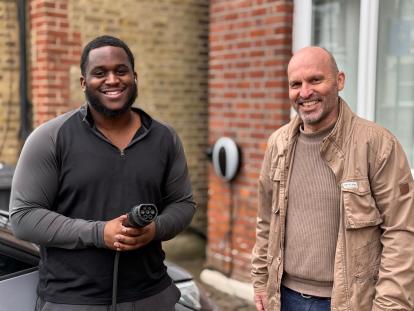
Greg is an EV owner from London and has been sharing his home charger since 2022. In that time, he has clocked up somewhere over 500 charging sessions, almost all of them by the same person, an Uber driver who lives nearby and cannot install a charger of his own.
Greg already had a home charger but he was only using it every couple of weeks. "It felt like a bit of a waste," he says. With a double driveway and space for another car, he realised he had an asset that could help someone else. "The idea that someone nearby could book in, come over and charge regularly, especially someone I'd get to know, just made sense."
In just over four years, Greg has hosted more than 500 charging sessions — almost all for the same local Uber driver. His regular chargee, Roman, is an Uber driver who lives in a flat nearby, which means he has no driveway and no way to install a charger of his own. Public charging was his only alternative, which can be expensive and unpredictable in a way a driveway charger is not. It would also lengthen his working day significantly.
The pattern that has built up between them is simple. He finishes a shift, then leaves the car charging at Greg's. "It works really well," Greg says, "because he can leave the car charging at my place, go home and then come back for it later." Over four years and hundreds of sessions, that arrangement has become entirely routine, for both of them.
Greg and Roman arrange their charging through a charger sharing app, with sessions booked ahead of time so Greg knows when a car will arrive. Greg sets his rate a little above what he pays for the electricity, helped along by a cheaper overnight tariff. "The main thing for me is that it feels fair. I'm not losing money, and I'm helping someone else out without really putting myself out." And charging at Greg’s is still cheaper and more convenient than a public charger for Roman.
Four years and 500 sessions in, Greg's advice to anyone considering it is straightforward. "If someone has a charger at home, isn't using it every night, and has some spare availability, I'd definitely recommend it," he says. "It's a nice way of helping someone nearby who doesn't have their own charger, and you can set it up so it doesn't inconvenience you. You also make a bit of money."
"Just do it. It's easy." Meet Ruth, who has been sharing her home charger since 2021

Ruth has shared her home charger for nearly five years and has hosted 180 charging sessions for people who cannot install a charger where they live.
"Most of my regular users live in houses or flats where they couldn't have a charger of their own installed," she says. For some, having access to Ruth’s charger has made EV ownership possible. One friend got an EV because Ruth encouraged her, "She's got nowhere to charge it, never will have when she's living in her current space. So, she relies on us."
Ruth says the reality of sharing her charger has been surprisingly simple. "All we have to do is remember to leave it turned on and take our car off the drive. It's not complicated at all." In five years, she's never had a dispute, any damage or a falling out with a user. "People have been lovely and grateful. Crazily grateful."
Her advice to anyone thinking about it: "Don't even think about not doing it. Just do it."
There are several charger sharing platforms available with different approaches fitting different scenarios. Could you share your home charger with a neighbour? To find out more, search for “home charger sharing” online.
^ Illustrative earnings calculations assume a single neighbour consuming 2,400 kWh a year (3 miles per kWh and 7,200 miles a year), or a professional driver consuming 9,000 kWh a year (2.8 miles per kWh and 25,000 miles a year). The calculations assume a total cost of provision of 27p per kWh, including fees and transfer loss, and a price of 37p per kWh, including transfer loss. Actual earnings depend on the platform, the host’s electricity tariff, pricing and usage.
^ Zapmap, Home and Community EV Charging statistics, August 2026. Zapmap estimates that nearly 1.5 million home chargepoints were installed in the UK at the end of 2025. The estimate of more than 9 million households without straightforward access to home charging includes households without a driveway and an allowance for households facing barriers associated with renting or other access issues.
^Co Charger operational data
^Co Charger operational data
^Data from Co Charger suggests less than 3% of hosts, once sharing, stop doing so within a year.