At a glance:
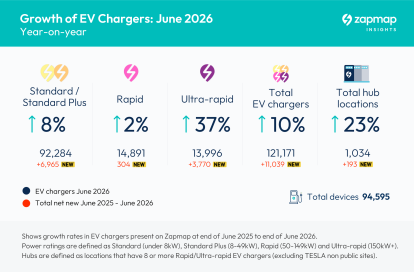
- UK public EV charging infrastructure expands 10%: The UK’s public EV charging network reached 121,171 EV chargers across 46,731 locations by the end of June 2026.
- On-street residential EV charger deployment leads: Driven by the needs of drivers without off-street parking, on-street charging infrastructure saw the highest year-on-year growth at 18%, expanding to 39,859 EV chargers.
- High-power network growth led by Ultra-rapid EV chargers: High-power public networks delivering 150kW+ speeds grew 37% year-on-year, bringing the total number of Ultra-rapid EV chargers to 13,996 across the strategic road network.
Zapmap has published new statistics on public EV charger installations in the first half of 2026.
The figures taken from the Zapmap platform at the end of June 2026 show 5,119 new EV chargers were installed in the first half of 2026. The EV charging infrastructure now encompasses 121,171 EV chargers at 46,731 locations representing a year-on-year increase of 10%.
Across different power bands and charging location categories spanning en-route, destination and on-street charging, this growth picture reveals a developing focus on two key areas: meeting the needs of the next wave of EV drivers, who may not have off-street parking, and providing high-powered charging throughout the strategic road network to support longer journeys.
On-street charging, designed for overnight or full-day use, and aimed at drivers who wish to charge close to home but do not have off-street parking, has seen the highest year-on-year growth at 18%. This use case now accounts for 39,859 EV chargers.
En-route locations, designed for drivers looking to recharge their vehicle as quickly as possible on longer journeys, now extends to 13,711 EV chargers and has grown 15.2% year-on-year.
The number of charging hubs across the country (defined as eight or more Rapid or Ultra-rapid EV chargers at a single location) now stands at 1,034, with 108 of them being added to the Zapmap database in the first half of 2026.
In parallel, the highest power-band growth continues to be seen in Ultra-rapid chargers delivering charging speeds of 150kW and above, which have seen 37% year-on-year growth. There are now 13,996 EV chargers in this power band, while Rapid chargers continue to see the lowest growth rate of all power bands, as devices are upgraded to higher power ratings with the potential to deliver a faster charging experience for EV drivers.
Significant new hubs since Zapmap’s last quarterly update include:
- GRIDSERVE announced the opening of its latest Electric Super Hub at Moto Lymm Services on the M6, comprising 24 Ultra-rapid chargers.
- GRIDSERVE also expanded its hubs at Cobham (M25 J9/10) and Peterborough (A1(M) J17) Extra MSA services, adding 42 extra Ultra-rapid chargers between the two sites.
- Osprey opened a new site at Lidl Belshill, Glasgow, situated on the A725, M74 and M8 and providing Ultra-rapid charging for 16 EVs.
- Fastned opened a new hub in Hemel Hempstead, comprising eight Ultra-rapid and two Rapid EV chargers.
- Working in partnership with Places for London, Fastned also delivered Ultra-rapid charging for 12 cars at Hatton Cross underground station, ideally situated for easy access from Heathrow Airport, the M25, M4 and A30.
- Source EV opened its charging hub featuring ten 150kW Ultra-rapid chargers at Edinburgh Business Park, an area which is expanding into a mixed use business / retail / residential location.
Destination charging, where people charge when stopped, rather than stopping to charge, covers several use cases, from retail sites through gyms and restaurants to theme parks. This category now extends to 62,609 EV chargers, representing 5.7% year-on-year growth. Whilst <50KW chargers form the majority here, for those cases with a sub-four hour dwell time, there is a trend towards installing more high-powered chargers, further supporting the strong growth in Ultra-rapid charging provision.
Developments over the past quarter include:
- RAW Charging installed charging provision at three retail sites: Cardigan Fields in Leeds, as part of its partnership with Landsec, featuring 12 Ultra-rapid chargers combined with 14 Standard Plus and six Rapid chargers, Leamington Shopping Park, with six Standard Plus and 11 Ultra-rapid EV chargers and Bagshot Park retail site, providing eight Ultra-rapid chargers for shoppers, while also convenient for travellers along the A30 and M3.
- In a busy quarter, RAW Charging also partnered with B&Q to provide charging at 26 of its retail sites, with installations already live at B&Q stores in Cheltenham, Sidcup, Boston, Stanmore and Galashiels.
- Believ partnered with Mitchells & Butlers to deliver EV charging infrastructure across 65 hospitality venues across the UK.
- Roam Charging announced a new partnership with Hand Picked Hotels to deploy charging infrastructure across its portfolio of luxury country house hotels and coastal resorts.
- Zest opened new charging facilities comprising six 120kW EV chargers at the Starbucks and Wendy’s drive-thru stores at Croft Retail Park in Bromborough, in partnership with franchise operator Café Fortune.
As EV adoption expands into the c.40 % of UK households without off-street parking, on-street charging is set to grow significantly. The majority of local authorities and combined authorities have now received allocations from the LEVI (Local Electric Vehicle Infrastructure) fund, although many are still at the tender, commercial contract and planning phases. While this use case has seen the highest recent year-on-year growth, we are likely to see further acceleration as contracts translate into chargers in the ground.
LEVI contract announcements over the past quarter include:
- char.gy will deliver a rollout of over 1,500 public EV chargers across the Isle of Wight, backed by £1.625 million of LEVI funding.
- char.gy has also been selected by Reading Borough Council to deliver its LEVI infrastructure, with plans for 2,600 chargers around the borough.
- Thurrock Council awarded Zest a contract to deliver up to 4,046 public EV chargers across the borough.
- Believ partnered with Hertfordshire County Council to deliver up to 3,974 Standard Plus chargers and 248 Rapid chargers across Dacorum, Hertsmere, Three Rivers and Watford, backed by £2.1m of LEVI funding.
- Hampshire County Council also selected Believ to deliver possibly the biggest LEVI contract signed to date, bringing 17,180 public EV chargers to the county supported by £6.6m of public funding.
- Connected Kerb and EZ-Charge were selected by Oxfordshire Council to deliver an additional 1,500 chargers throughout the county.
Simultaneously, Zapmap’s statistics show progress in the regional distribution of high-powered chargers this year: nine out of 12 geographical areas of the UK now have over 2,000 50kW+ chargers and four of those have over 3,000. Of particular note, Northern Ireland (24%), the North West (22%) and East of England (22%), are the regions with the strongest year-to-date growth in high-powered chargers.
Melanie Shufflebotham, Co-founder & COO at Zapmap, said:
“At a time of so much activity in the charging industry, it seems counterintuitive that the growth of the charging infrastructure is lower than we have been used to over the past couple of years. This shifting growth landscape reflects a transition from the rush to secure prime locations into the next phase of development, combining more considered expansion and a growing number of network mergers and acquisitions. Charge point operators are learning and focusing on what the data shows about EV driver preferences and usage patterns and we’re seeing this reflected in the numbers.”
Jade Edwards, Head of Insights at Zapmap, said:
“The growing focus of charge point operators on utilisation rather than primarily on deployment will ultimately be good news for EV drivers, ensuring that the right chargers are installed in the right locations. Ever-increasing charger power is a story we’ve seen unfolding over the past twelve months, opening up the potential for faster charging sessions and therefore increased usage across the same number of EV chargers.”
“Meanwhile, several factors are driving shorter term data fluctuations: network operators are responding to Public Charge Point Regulations by tightening up the quality of data flowing into eMSPs like Zapmap, poorly performing chargers are taken out of public use, while other chargers temporarily drop out of view while transferring from one back office or network to another.”