At a glance:
- Growth bias towards high-powered and en-route charging continues
- 144 new hub locations since the start of the year
- Local Electric Vehicle Infrastructure contract awards a continued focus
Zapmap has published new statistics on public EV charger installations for the first nine months of 2026.
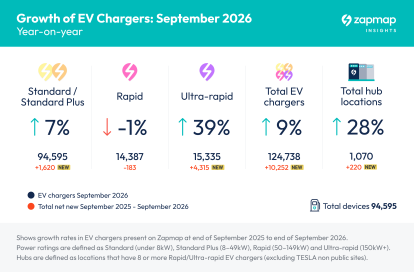
Figures for Q3, taken from the Zapmap platform at the end of September 2026, show 8,686 new EV chargers* were installed in the first nine months of 2026. The EV charging infrastructure now encompasses 124,738 EV chargers at 48,298 locations representing a year-on-year increase of 9%.
Across different power bands and charging location categories spanning en-route, destination and on-street charging, growth continues to be most pronounced in high-powered charging to support longer journeys throughout the strategic road network.
En-route locations, designed for drivers looking to recharge their vehicle as quickly as possible on longer journeys, have seen the highest year-on-year growth at 23.1% year-on-year. This use case now extends to 14,053 EV chargers.
The number of charging hubs across the country (defined as eight or more Rapid or Ultra-rapid EV chargers at a single location**) now stands at 1,070, with 144 of them being added to the Zapmap database through 2026 to date.
In parallel, the highest power-band growth continues to be seen in Ultra-rapid chargers delivering charging speeds of 150kW and above, which have seen 39.1% year-on-year growth. There are now 15,335 EV chargers in this power band, while Rapid chargers continue to see the lowest growth rate of all power bands with no overall growth year-on-year in September, as devices are upgraded to higher power ratings with the potential to deliver a faster charging experience for EV drivers.
Significant new hubs since Zapmap’s last quarterly update include:
- Moto at Tamworth services on the M42, under its own network brand, Moto CHARGE, which provides 12 Ultra-rapid EV chargers.
- GRIDSERVE’s fifth Electric Forecourt, located on the M1 at Markham Vale, Derbyshire. The site has 39 Ultra-rapid EV chargers.
- bp pulse at Tingley West, Yorkshire, featuring 19 Ultra-rapid EV chargers, a dedicated pull-through bay for trailers and caravans, accessible bays and a Starbucks.
- Fastned’s 40th UK hub, located at Brunswick Business Park, Liverpool, and providing eight Ultra-rapid EV chargers.
- RAW Charging’s new sites in Wolverhampton, Huntingdon and at the Stadium of Light in partnership with Sunderland AFC.
Destination charging, where people charge when stopped, rather than stopping to charge, covers several use cases, from retail sites through gyms and restaurants to theme parks. This category now extends to 64,289 EV chargers***, representing 4.26% year-on-year growth. Whilst <50KW chargers form the majority here, for those cases with a sub-four hour dwell time, there is a trend towards installing more high-powered chargers, further supporting the strong growth in Ultra-rapid charging provision.
Developments over the past quarter include:
- Allego announced plans to invest €100 million in installations of up to 1,400 new Ultra-rapid EV chargers in high-traffic and densely populated areas, delivered through partnerships with retail and hospitality businesses.
- RAW Charging continued its rapid roll-out in key leisure, hospitality and retail sites, with new EV Chargers at three National Trust sites in Devon, XScape leisure complex in Milton Keynes, Chichester Gate Leisure Park and RHS Garden Wisley, among others.
- InstaVolt extended its partnership with British Land to bring charging provision to 18 retail sites with five already live and on-site battery storage at key locations.
- Zest partnered with the Heart of England Co-op to roll out Ultra-rapid EV charging facilities across nine stores in the Midlands.
On-street charging, designed for overnight or full-day use, and aimed at drivers who wish to charge close to home but do not have off-street parking, now accounts for 41,374 EV chargers, representing a year-on-year growth of 13.4%. As EV adoption expands into the c.40 % of UK households without off-street parking, on-street charging is set to grow significantly.
The majority of local authorities and combined authorities have now received allocations from the LEVI (Local Electric Vehicle Infrastructure) fund, although many are still at the tender, commercial contract and planning phases. LEVI contract announcements over the past quarter include:
- char.gy has been appointed to deliver a rollout of 3,000 EV chargers across West Northants.
- Hertfordshire County Council partnered with Zest to deliver over 1,000 EV chargers across the borough and district councils of North Hertfordshire, St Albans and Welwyn Hatfield.
- Connected Kerb is working with Bedford Borough Council to bring 900+ chargers to the area.
- Devon County Council and Torbay Council have selected Believ to manage the installation of 1,300 chargers across the region.
Figures on the growth of the public charging network are taken from Zapmap’s Locations dataset, which shows the location types, power-bands, networks and use-cases of EV chargers across the country, and which also underpins the Department for Transport’s official EV charging infrastructure statistics.
This month, Zapmap pricing data also shows that the cost differential between EV and petrol / diesel vehicle running costs is at its highest since Zapmap’s tracking began. A typical EV driver doing 20% of their charging on the public network can now expect to save £1,130 in fuel costs and, for the first time, even EV drivers without access to home charging and who are wholly reliant on the public network will often be better off than a driver of a comparative petrol or diesel car.
Melanie Shufflebotham, Co-founder & COO at Zapmap, said:
“We know that charging hubs are the most popular choice of charging location for Zapmap’s EV driver community, so it’s fantastic to see all the new hubs rolling out, with the highest growth being in Ultra-rapid charging provision.
“With new EV registrations hitting a record of nearly 100,000 in September, continued growth of reliable and plentiful public charging infrastructure is essential, so it’s good to see the Government turning attention to grid resilience and speedier grid connections last week through the creation of Great British Grid. Action taken in parallel to address charging costs across all use-cases would help to ensure continued momentum in the transition to clean mobility.”
Shane Brennan, CEO of Charge UK, said:
“As we see record numbers of drivers make the switch to electric, the significant year-on-year growth in high powered chargers and EV hubs shows that the charging industry is getting on with the job of installing the high-quality infrastructure they need.
“The industry is also underway with roll-out of the many thousands of on-street chargers which are now contracted with local authorities all around the country. The comparative slowness, combined with the cost disparity between home and public charging, risks exacerbating the ‘driveway divide’ between those who can charge at home and those who cannot.
“The fact that all EV drivers can now save compared to the skyrocketing petrol and diesel prices should be celebrated. Government must hold their nerve and stand firm on EV sales quotas and addressing the policies that are pushing up public charging prices."